Living to make art is a luxury; writing is a privilege; and thinking in liberation is an earned responsibility.
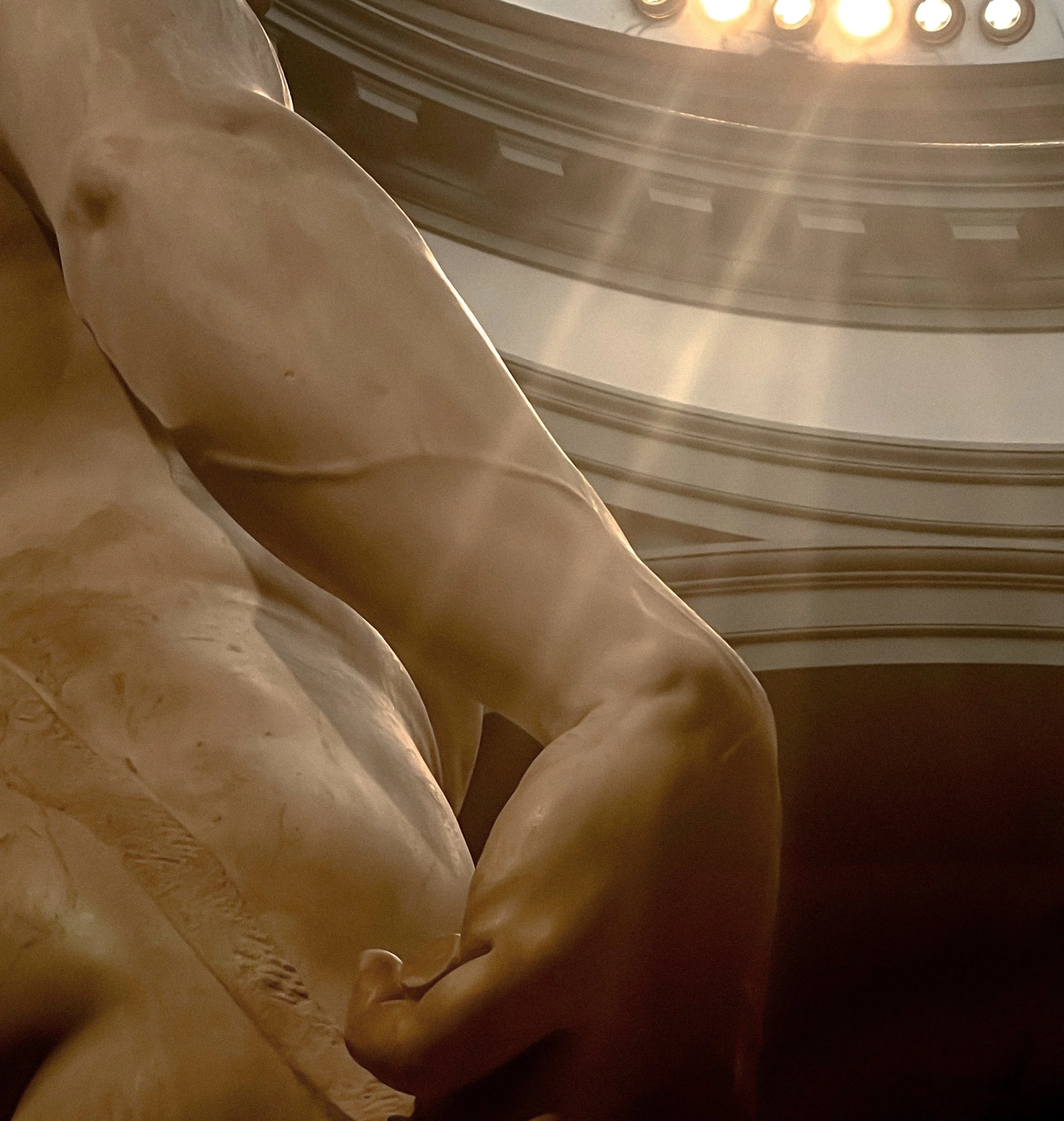
Blessed by a recent Italy trip, I was able to make a detour to Michelangelo’s David during a daytrip to Florence. My hyper self-awareness already alerted me to skip the clichéd description of my experience with the sculpture itself, or mentioning any fine art mumble-jumble. The tragic but poetically named ‘Prisoners’ or ‘Slaves’ that shaped the path under the feet of the Great David were written at length by many scholars and visitors. Now, I knew that there was something spectacular about this visit, but how do I make it into a blog post worth reading?

Wow — was my first verbal response upon setting foot in the long welcoming corridor. Even situated on the far side of the horizon, all the heads were still tilted to appreciate this immaculate block of marble cut and carved 500 years ago. But the realisation kicks in after mere seconds, that’s it, there is nothing more after the initial wow. The thought alone disappointed me more than anything, more than the act of encountering something disappointing itself.

Don’t get me wrong, being deliberately antisocial to dislike mainstream media symbols is not the purpose of this text, in fact I think David is one of the best sculptures that I managed to visit and witness under my eyelids, the anatomic understanding of Michelangelo delivered by the intentional exaggeration of hands and head can only work its magic as you breathe the same air as the other thousand or so visitors. However, there is just something so fundamentally wrong about being able to contain myself in front of a monument so widely praised by humanity for generations. The angsty pursuit of something deeper, wanting to see more, understand more and feel more are no strangers in galleries. Humans in our long-developing civilisation learnt to study for meaning amid cultural and artistic icons. But since when did we stop asking questions? How do we know we are approaching art the wrong way?

This writing derives from my university dissertation Faith, Assets, and Politics: Shock Arts in Social Context, which analysed three artworks by contemporary artists Jacek Markiewicz, Dread Scott and the art student buzzword Damien Hirst. Hirst’s works are always tricky to dissect, art students never fail to find words that sum up his madness- capitalist, commodity, mortality and whatnot. Such a phenomenon is not such a wild concept to comprehend. Hirst covers basic human conditions, sex, money and death, using the easiest medium and language, skulls and corpses for death, butterflies for beauty, blah blah blah (I cannot bear myself talking about Hirst again and again). Everything that an aspiring art student in 21st Century would obsess over. Art makers such as myself often find themselves chasing after big ideas, ultimately it is more satisfying knowing that the blue in the author’s curtain signifies sadness, than being informed that it is just a stylistic choice. In an age where everything seems to have already been made, we thirst for originality, we drool for the association between big words and ordinary items, we sketch and sketch, hoping a new idea pops up that can conveniently be uttered to our peers, using buzzwords that some critics used in a Guardian article.

The initial purpose of starting a blog is to avoid the restrictions posed by academic writings, of constantly having to over-explain historical context and insert a reference here and there. However, the dynamic of whether my words hold the power to speak for a wider audience or art students as a whole still stands as a troublesome annoyance as I type. Ask anyone who has ever read an art book at least once, there was always that one instance where the writer wrote in first-person pronouns “we/us” and succeeded in being relatable.
Here comes the question: the unending cliché of ‘art is subjective’ implies that there are infinite pluralistic ways of interpreting art and how each individual incorporates art in their lives. How do writers know it is a ‘we’ and not a ‘them’? How do artists make sculptures that strum the heartstrings of every soul on the planet? How does a painter wave a brush so elegantly to make people weep? It is virtually impossible for a writer to describe a universal experience despite their mountainous amount of research or profound insight into life; and impossible for an artist to please everyone, no matter their dedicated craftmanships or artistic languages. One can never speak for all.
Do you think Bill and Hilary Clinton ever giggled over a fart under the blanket? Ever wondered Dahmer’s connection with his victims is stronger than the bond of those passionate lovers in front of the Eiffel Tower? These are strange questions to some, but why? We live intimacy all differently; it barely matters whose name I used in these examples. Instead, the provocation provided by these absurd thoughts brings us to extend ourselves, beyond our own experience and explore intimacy as a whole. To put it simply: what you make and what you create is not the first step of art-making; why you want to make it, and why it is something worth discussing should be the utmost important initiating step.
Having now almost 4 years of formal art education, it became clear to me that I had once fallen victim to making cliché arts, just as a great portion of art students fail to resist submitting to grand ideas, subject matters of the macabre and grotesque, hoping to find a shoe that fits their feet. It is truly a terrible feeling not being able to converse about your own artwork, trying to convince people into appreciating the work that you injected philosophical buzzwords and art jargon within, sucks the fun out of art, because the work is no longer important to you. And when one doesn't connect to their work, it ceases to hold any value but an amateur attempt at imitating what great artists did.
Do you think Damien Hirst (I swear this is the last time) sat in front of his desk and carefully calculated that dipping a dead shark in a tank would bring him generational wealth? It is no more than a shower thought; great art doesn’t appear entirely based on what amazing one-liner one has to offer, but the artist’s ability to develop and phrase that idea into something heartfelt and enduring.
Showering holds this magical property of summoning the wildest thoughts within a day. As an artist, I can’t think of a better workspace than underneath the streams of steaming running water.
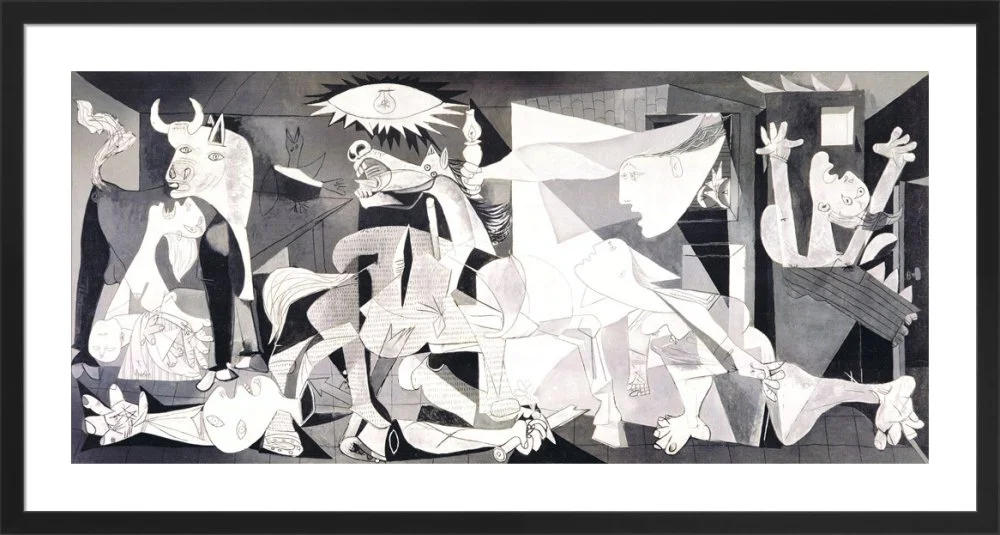
This piece of writing is a paracetamol to me, and in fact, I do feel better now about the lack of persisting excitement upon my visit of David, I don’t really care whether it is carved out of marble, wax, dirt or whatnot. I don't feel the need to make it more interesting by reading more about it, but it made me think, and I did ask a lot of questions while writing this. Without asking why I was disappointed at the sculpture, I would not be able to produce this writing; all experience matters when examined in a certain scope. If I were presented with the most contextually rich art piece but given no time before having to converse about it, even the Guernica would be more dull than my 5-year-old cousin’s doodle.
Be ridiculous, ask questions, take more showers.